A practical, field-verified breakdown of clearance procedures, crew immigration, visa rules, documentation requirements, and what actually causes delays at the customs dock.
The Adriatic is one of the world’s most sought-after superyacht cruising grounds.
Croatia’s endless coastline and Montenegro’s spectacular Boka Bay continue to attract growing yacht traffic each season. But it is the short stretch between Dubrovnik and Boka Bay that often determines the quality of an operation, where delays, port congestion, and poorly managed information directly impact guest experience, crew efficiency, and the guest’s most valuable asset onboard: time.
What every successful Adriatic season requires, however, is a clear understanding of two distinct clearance systems.
Croatia is a full EU Schengen member with all the documentation requirements that imply. Montenegro is non-EU, Schengen-associated in a limited sense, and operates its own procedures, which offer genuine operational flexibility in some respects and require careful coordination in others.
This guide sets out exactly what captains, chief officers, and pursers need to know before entering either country. It is based on operational intelligence compiled by A+ Yachting – your dedicated agent for Croatia and Montenegro.

Croatia: EU Clearance, CIMIS Pre-Filing and EES Biometrics
If you are arriving from an EU country, you may sail freely to any port, marina, or anchorage in Croatia. However, this does not exempt you from legal obligations, including notifying authorities of your arrival, declaring all crew and guests on board, and obtaining the national navigation permit (vignette).
In Croatia, all yachts must announce their arrival at least 24 hours in advance, regardless of whether they are coming from an EU or non-EU country. Additionally, for yachts over 45 m, all movements have to be recorded in CIMIS, which is the Croatian Integrated Maritime Information System on the national level and mandatory for use.
From 2026, the Entry/Exit System (EES) requires digital biometric registration for all non-EU nationals. For superyacht operations, this means one unambiguous practical requirement: every non-EU crew member and guest must be physically present at the customs dock if coming from a non-EU country. Biometric registration cannot be pre-processed remotely.
🇭🇷 CROATIA – Schengen · EU Member · EES biometrics from 2026
Clearance Procedure
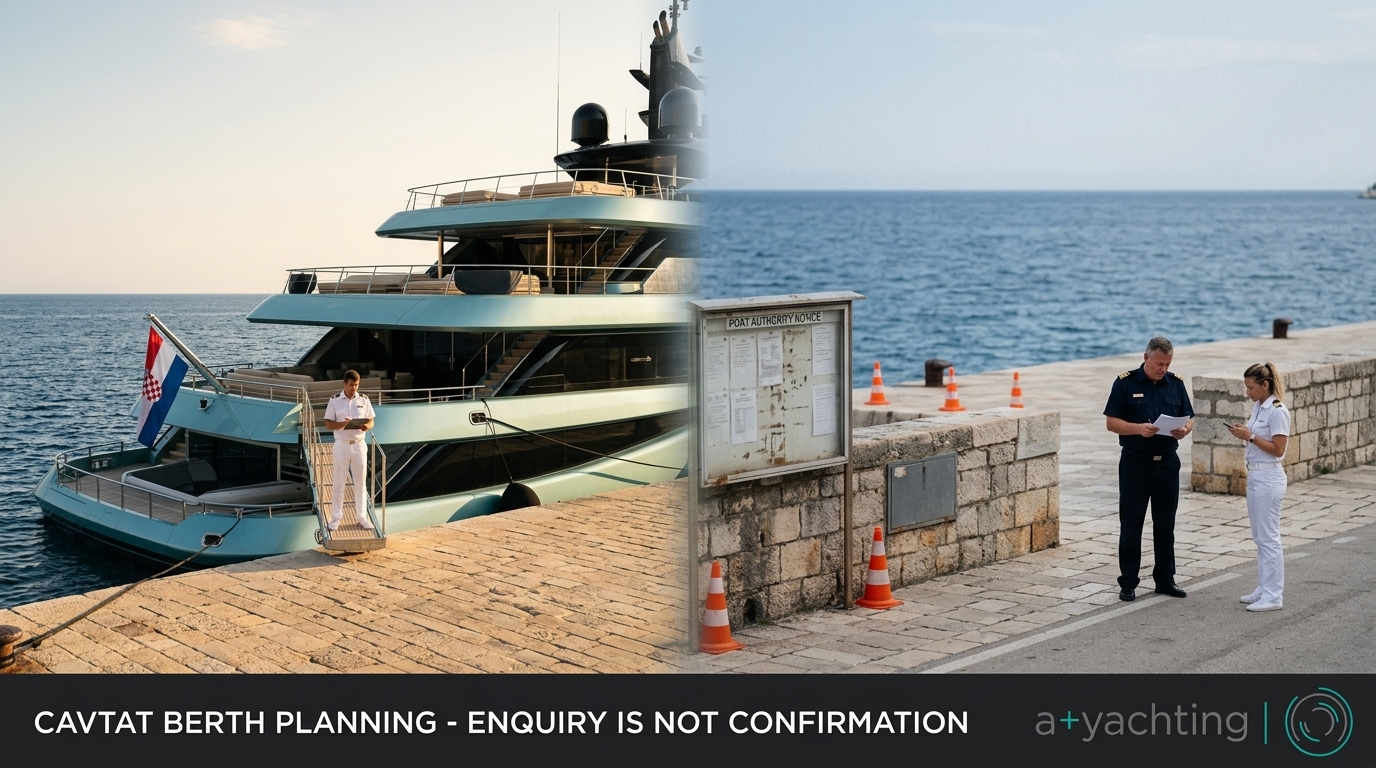
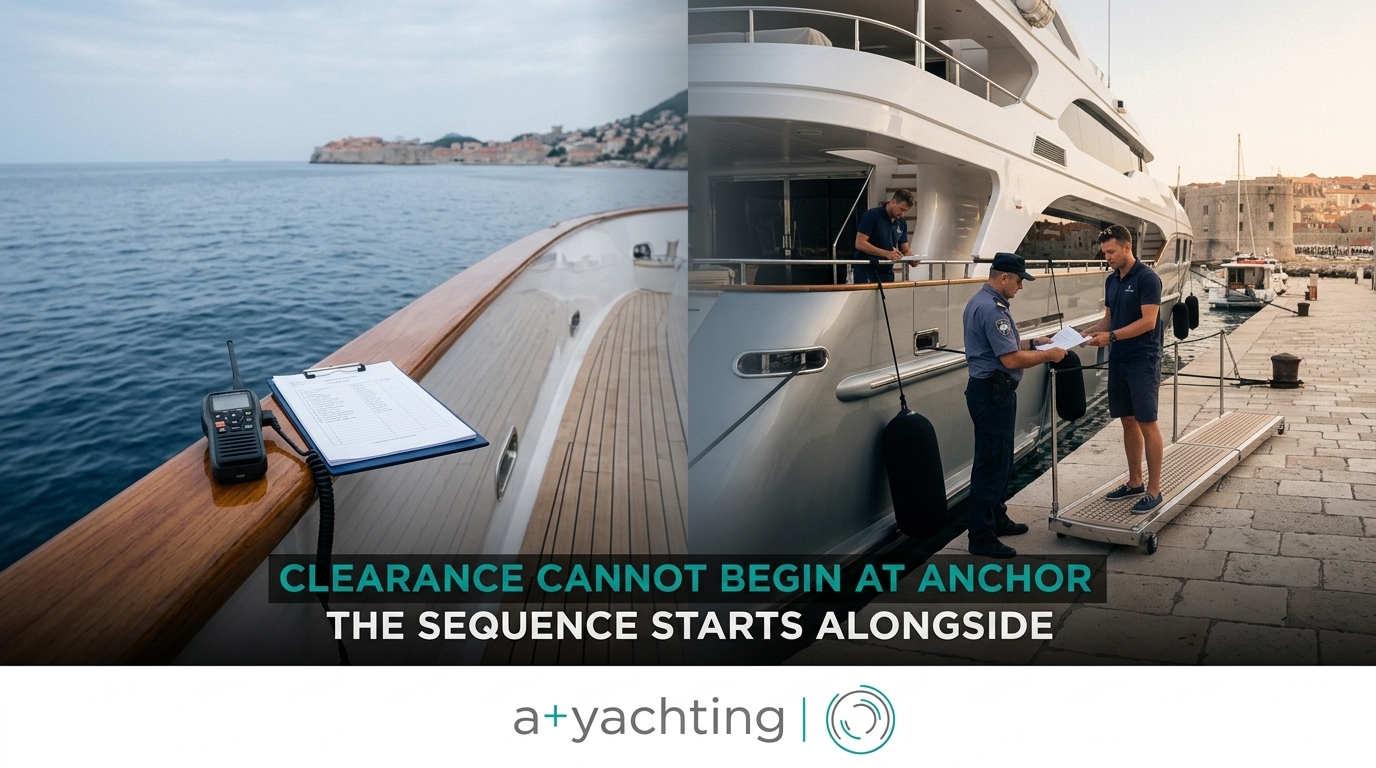
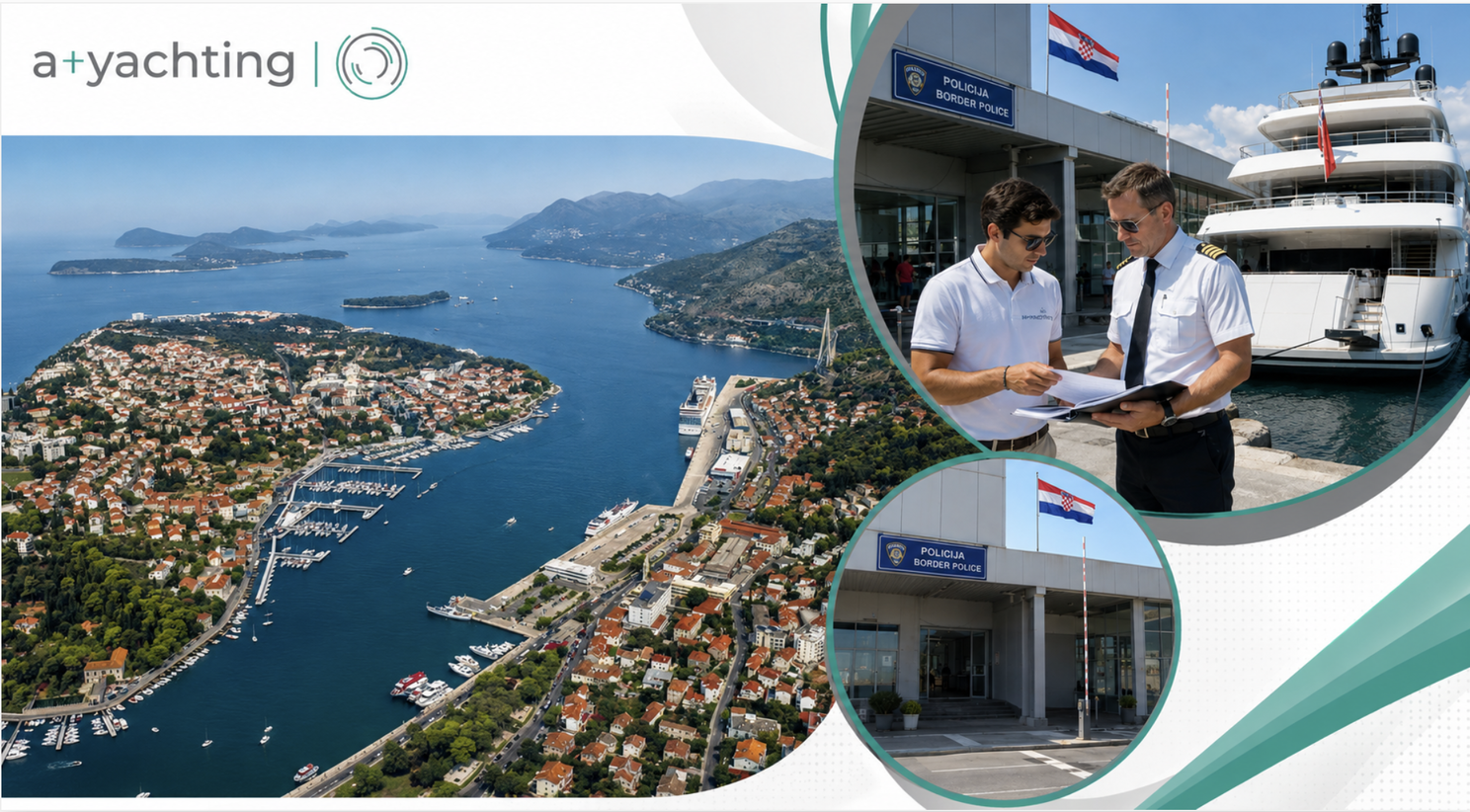
All vessels arriving from outside the EU must clear at an official Croatian customs dock. Croatia does not permit clearance from anchorage under any circumstances, this is not situational, not subject to the agent’s negotiation, and not something that has exceptions in peak season. The vessel must berth at a designated customs pier.
For vessels over 45m LOA, all documentation is submitted digitally through CIMIS. This allows navigation permits and clearance to be processed in advance of arrival. The agent handles CIMIS submissions. For vessels under 45m, standard documentation is presented on arrival.
Clearance Key Facts
• Typical clearance time: approximately 1 hour under normal conditions
• Advance notice: 24 hours minimum; vessels 45m+ submit via CIMIS
• Anchorage clearance: not possible — all vessels dock at official customs pier
• Crew attendance: case-by-case at authority discretion
Croatian Clearance Ports
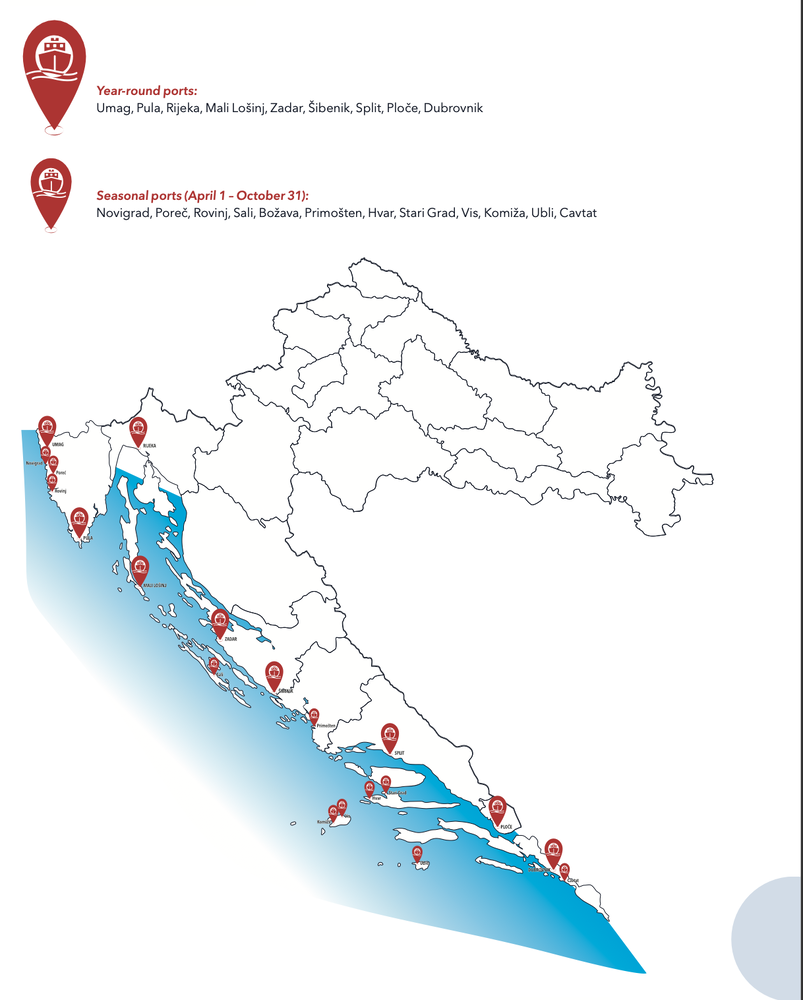
Year-round: Umag, Pula, Rijeka, Mali Lošinj, Zadar, Sibenik, Split, Ploce, Dubrovnik.
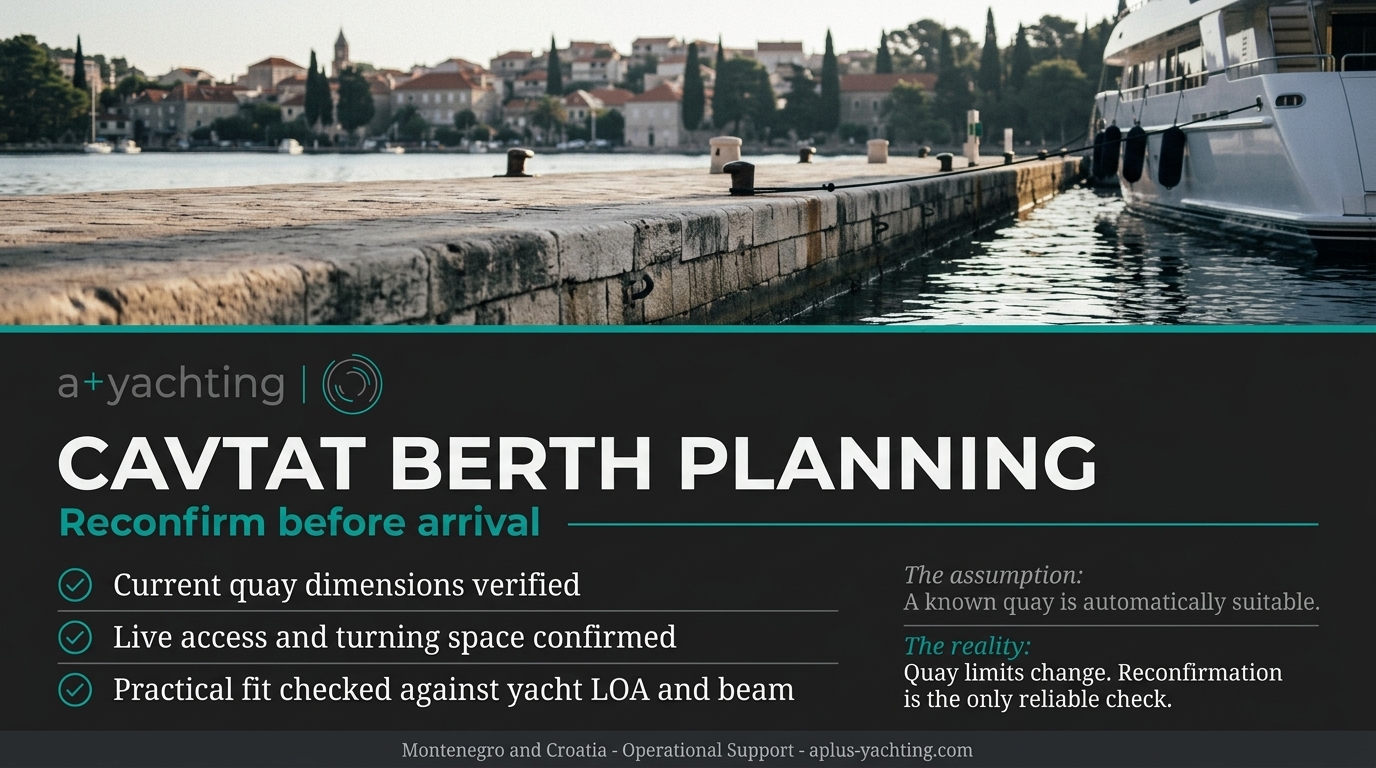
Seasonal (1 April to 31 October): Novigrad, Porec, Rovinj, Sali, Bozava, Primosten, Hvar, Stari Grad, Vis, Komiza, Ubli, Cavtat.
What Causes Delays at Croatian Customs?
• High seasonal traffic at customs docks – July and August at Split, Dubrovnik, and Hvar are the highest-risk periods
• First-time EES biometric registration from 2026 – build additional time into schedules for all non-EU crew and guests on first Schengen entry
• Incomplete documentation – missing seaman’s books, discrepancies between crew lists and actual crew, absence of crew contracts
• System connectivity issues at smaller customs docks during the shoulder season

Crew Immigration in Croatia
Crew movements are recorded by Border Police and, from 2026, logged digitally via EES – no physical passport stamping. Crew joining by air enter Schengen as normal travellers, then the agent escorts them to the Border Police for official sign-on. Required: passport, seaman’s book, or employment contract.
Crew signing off must complete the official sign-off at the Border Police before proceeding to the airport. This updates their status from ‘on duty’ to ‘traveller’ in the EES system. Do not send crew directly to the airport without a formal sign-off – it creates an EES discrepancy that will cause problems on their next Schengen entry.
Crew Without a Visa in Croatia
With a valid seaman’s book and crew contract, a crew member without the required visa may remain onboard with movement restricted to the vessel’s immediate area. Shore leave is not permitted. There are no legal alternatives to a visa in Croatia – seafarer documents support identification but do not replace visa requirements.

Montenegro: Flexible Anchorage Clearance and Schengen-Neutral Status
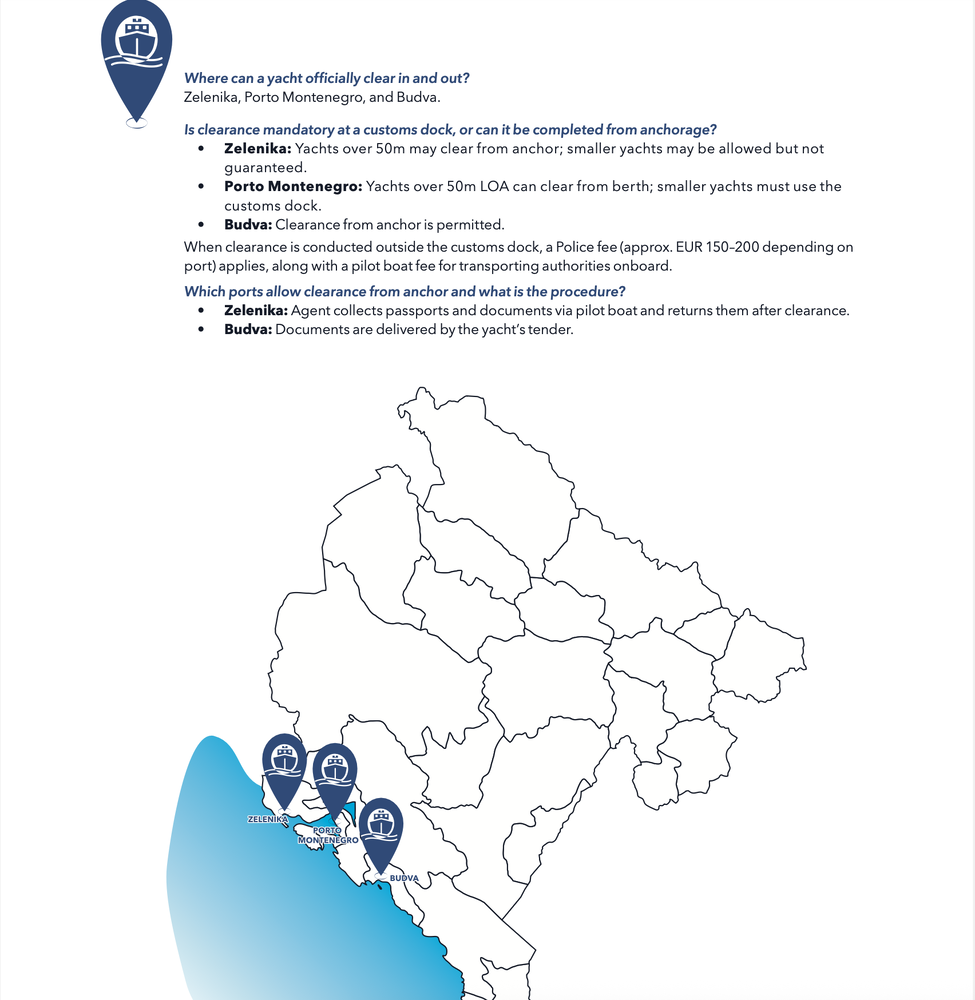
Montenegro’s clearance system offers genuine operational flexibility not available in Croatia. Three ports handle official arrivals: Zelenika, Porto Montenegro, and Budva. Each has different procedures. For larger yachts, the anchorage clearance options are a meaningful practical advantage.
🇲🇪 MONTENEGRO – Non-EU · Schengen-Associated · Anchorage Clearance Available, but subject to additional approval of Authorities and their genuine availability
Clearance Options by Port
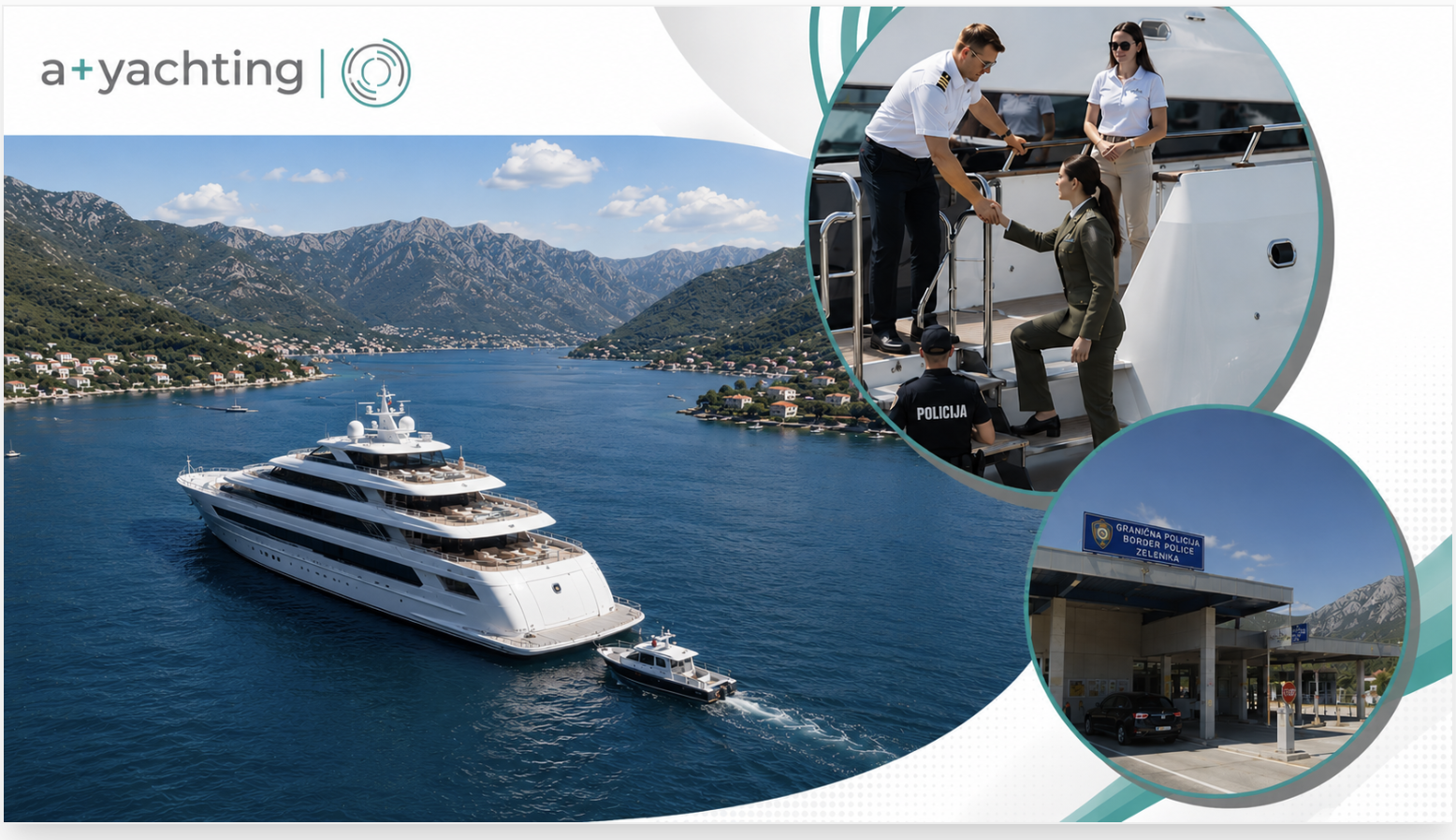
Zelenika: Large yachts may clear from anchor. The agent collects passports and documents via a pilot boat and returns them after clearance. I want to make clear that this is not guaranteed – confirm with the agent before arrival.
Porto Montenegro: Yachts over 50m LOA (stated in COR) clear from berth. Smaller yachts use the customs dock.
Outside-dock clearance carries a Police fee of approximately EUR 150 to 200, depending on the port, plus a pilot boat fee.
Budva: Clearance from anchor is permitted. Documents are delivered by the yacht’s own tender. Most operationally convenient for yachts at anchor.
Montenegro Clearance Key Facts
• Typical clearance time: approximately 1 hour (if coordinated well to avoid port congestion)
• Advance notice: minimum 24 hours
• Pre-filing: available via agent through Maritime Central Database – recommended for faster processing
• Outside-dock clearance fee: EUR 150 to 200 Police fee plus pilot boat
• Same procedure for private and commercial yachts
The Schengen Advantage: Days in Montenegro Do Not Count
This is one of the most operationally valuable and least understood aspects of Montenegro: although Montenegro is a Schengen associate:
Time spent in Montenegro does NOT count toward the 90-day Schengen stay limit.
There are no formal stamp-in/stamp-out procedures for crew in Montenegro. The practical implication is direct: a crew member who has accumulated 75 Schengen days can spend 30 days in Montenegro without consuming a single additional Schengen day. This is not a grey area or a workaround. It is how the Schengen framework applies to Montenegro.
For crew managing long Mediterranean seasons with Schengen day exposure, Montenegro offers genuine operational breathing room without leaving the Adriatic. Plan it into your crew rotation.
Crew Immigration in Montenegro
Once onboard, all crew must be registered at the local Tourist Office using their passport within 24 hours of joining. The crew list must be updated at the Harbour Master’s office. There is no formal sign-off procedure on departure – crew leaves via the airport with standard passport control.
Most Common Mistake: Failure to notify the agent of new crew or guests joining is the single most frequent immigration error in Montenegro. The 24-hour Tourist Office registration window is firm. Tell your agent immediately when any new crew member or guest boards.
What Happens Without a Visa in Montenegro?
Montenegro offers more flexibility than Croatia.
Crew without the required visa may be issued a shore pass.
Guests without a visa are not permitted in any of these countries.
But in Montenegro (unlike in Croatia) accepted visa alternatives include Schengen visa, US B1/B2 visa, EU residence card, and UAE residence card. However, crew arriving without the yacht cannot transit to the vessel – they must depart with the yacht unless special Police permission is obtained.