Port clearance, crew immigration, bunkering, charter compliance, provisioning, VIP arrivals and the operational details that define – or derail – an Adriatic season. A working reference for captains, chief officers and pursers.
This guide is a working operational reference for captains, chief officers and pursers planning seasons in Croatian and Montenegrin waters. It reflects field-verified intelligence compiled by A+ Yachting – your dedicated agent for Croatia and Montenegro, and covers the practical realities of the 2025 and 2026 seasons.
It covers what you will encounter, what will slow you down if you are unprepared and where the system offers genuine advantages when you know how to use it.
This guide is designed for real-time decisions at sea – not theory. Each section highlights what matters most: time, risk, cost and operational impact. If something is not confirmed in advance, assume it will become a problem in peak season.
Section 1: Pre-Arrival – Setting Up for a Clean Entry
The most effective way to avoid clearance delays in both Croatia and Montenegro is to begin your agent communication before the 24-hour legal minimum – ideally 72 hours before arrival in any new country. Most documentation problems that create dock-side delays are resolvable in advance if there is time to address them.
What to Pre-File in Croatia
- CIMIS submission for vessels 45m and over: crew list, guest list, navigation permit – all submitted via agent
- Ensure all seaman’s books are current and the crew list matches passport details exactly – discrepancies are the leading delay cause
- For commercial yachts: charter agreement, fiscal representative confirmation, VAT documentation
- 24-hour advance notice is the legal minimum – 72 hours is the operational standard
What to Pre-File in Montenegro
- Maritime Central Database pre-filing via agent – available and strongly recommended
- 24-hour notice minimum
- Confirm anchorage clearance availability at your specific arrival port before departure – not all locations guarantee it
- Confirm yacht stamp location onboard for bunkering documentation
Operational Standard: 72-hour agent briefing before each country entry – not 24. The legal minimum is the floor. Pre-filing 72 hours ahead gives the agent time to identify documentation issues before they become clearance delays.
Section 2: Clearance – What Actually Happens at the Dock
Croatia: The Reality
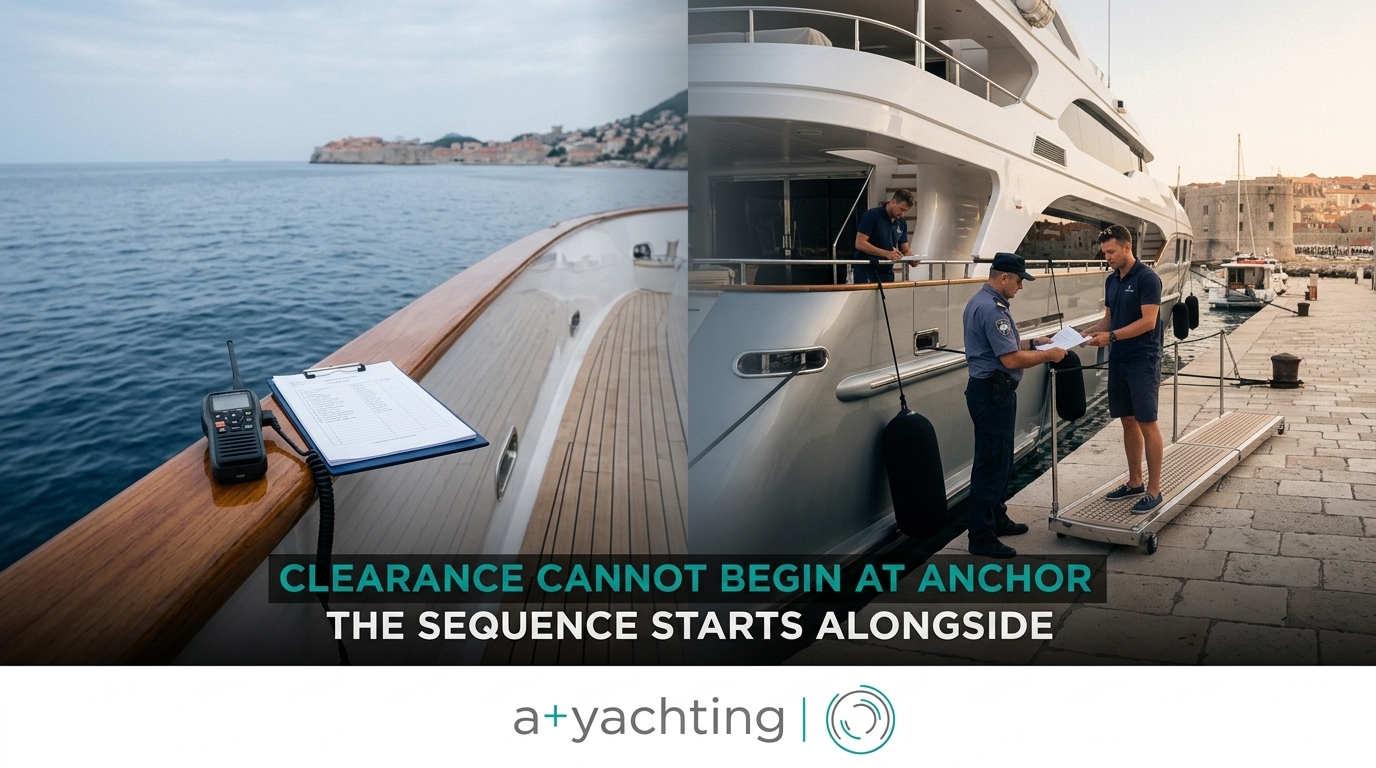
Your vessel berths at the customs pier. Border Police board and process all crew and guests. From 2026, all non-EU individuals undergo EES biometric registration in person – this cannot be pre-processed remotely. Budget 1 hour minimum; in peak season at Dubrovnik, Split or Hvar, plan 90 minutes.
The agent has pre-filed via CIMIS and coordinates with Border Police on your behalf. For crew sign-on, the agent escorts crew to Border Police. For crew sign-off, crew must complete official sign-off before proceeding to the airport – going directly to the airport without Border Police sign-off creates an EES record discrepancy that will affect the crew member’s next Schengen entry.
Montenegro: The Reality
Your options depend on port. Budva: send documents by tender. Porto Montenegro for vessels 50m and over: clear from berth. Zelenika for vessels 50m and over: agent comes via pilot boat. Clearance takes between 25 minutes and 1 hour.
Outside customs dock clearance at Porto Montenegro or Zelenika costs EUR 150 to 200 in Police fees plus pilot boat cost. For vessels making frequent Montenegro calls, this fee is a known and manageable operational cost rather than a surprise.
Schengen Management: The Core Principle
Croatia is full Schengen. Every day counts. EES will track this digitally from 2026. There is no flexibility in Croatia for crew who have reached their 90-day limit.
Montenegro is Schengen-associated but days in Montenegro do not count. A crew member at 80 Schengen days can spend 4 weeks in Montenegro without using a single additional day. Plan crew rotations with this in mind – it is a genuine scheduling tool for long Adriatic seasons.
Section 3: Bunkering – Fuel Planning for the Season
The Fundamental Difference Between Croatia and Montenegro
Croatia offers tax-free fuel only to commercial yachts over 45m, with a mandatory departure from Croatian waters after bunkering.
Montenegro offers tax-free fuel to all yachts – private and commercial, any LOA – with the same mandatory departure condition.
For private yachts of any size, Montenegro is the only tax-free bunkering option in this corridor. For commercial yachts over 45m, both countries offer tax-free fuel, and the decision comes down to itinerary alignment.
The Departure Condition: Working With It, Not Against It
Both countries require departure after tax-free bunkering. Experienced operators plan bunkering as a passage trigger, not a standalone stop:
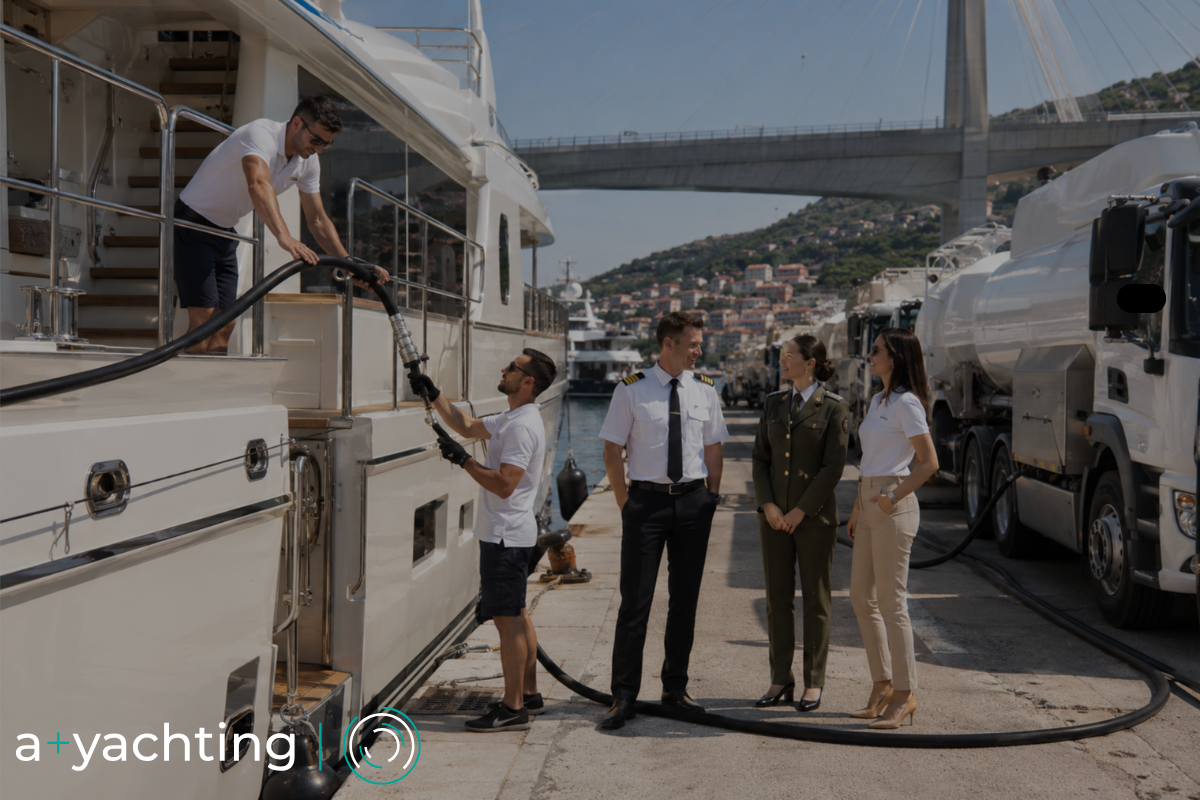
- Bunker in Split or Dubrovnik at the end of the Croatian leg before heading south
- Bunker in Porto Montenegro at the end of the Montenegrin stay before a passage toward Greece or Italy
The departure condition then aligns with the planned route rather than creating an additional obligation.
Booking Lead Times
- Croatia standard: 48 to 72 hours in peak season; approximately 5 days for large quantities
- Montenegro standard: approximately 48 hours under 200,000 litres; 3 to 4 days for larger orders
- Both countries: book the moment itinerary is confirmed in July and August – slots fill quickly at key ports
Section 4: Charter Compliance – The Captain’s Legal Exposure
The captain is legally responsible for charter compliance in both countries. Understanding the regime is a professional requirement.
Croatia: What the Captain Must Confirm Before the First Guest Boards
Charter licence is in place. Fiscal representative is appointed. Charter agreement is signed, declared and VAT-compliant. These three items must be confirmed and documented before any charter guest boards in Croatian waters.
If a Croatian maritime authority inspection occurs – and they do occur at key ports – the captain will be asked to produce the licence, the charter agreement and the fiscal representative documentation. These must be immediately accessible onboard. ‘The management company has it’ is not an adequate response during an inspection.
Montenegro: What the Captain Must Ensure
Montenegro requires no local charter licence for cross-border operations. The captain’s responsibility is to ensure the charterer remains continuously onboard when operating under a charter that began in another country. If the charterer disembarks in Montenegro, the cross-border charter basis becomes uncertain.
Operational compliance in Montenegro: speed limits are enforced, jet ski regulations are actively policed and are among the most common sources of fines, and Budva is heavily congested in peak season. Charter guest briefings must cover Montenegro-specific rules explicitly — assuming Mediterranean norms apply will result in fines.
Section 5: VIP Arrivals and Guest Logistics
The Best Ports for VIP Arrivals
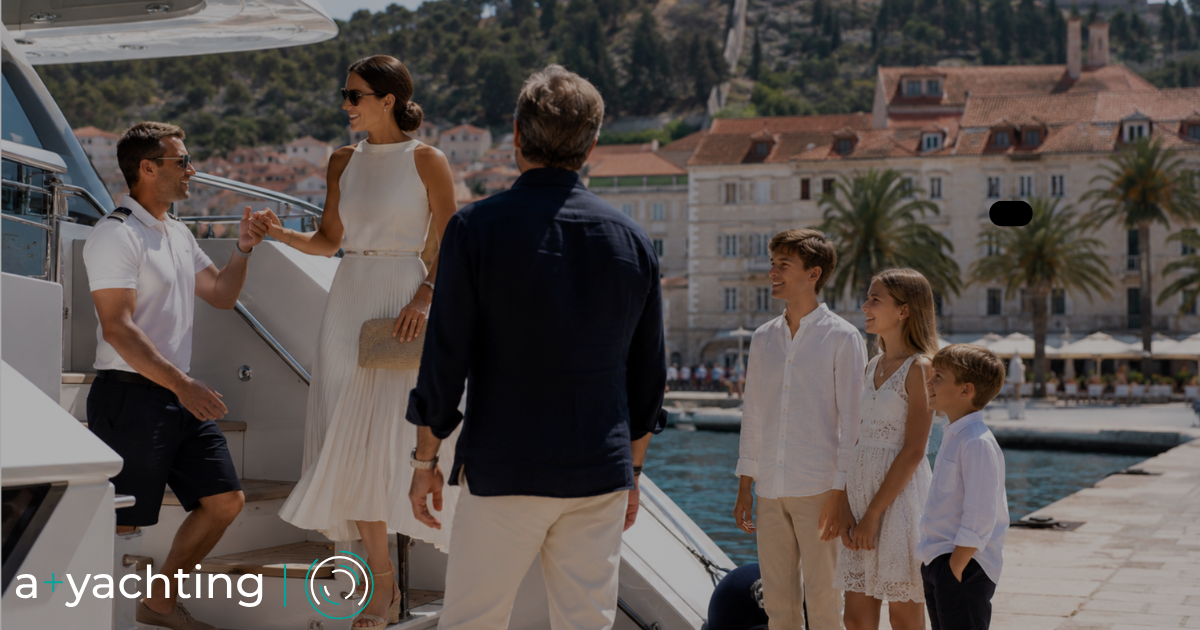
Croatia: Dubrovnik Airport is 20 to 30 minutes from the port and handles private aviation. Split Airport serves central Dalmatia. For northern Croatia itineraries, Pula Airport provides clean access.
Montenegro: Tivat Airport is 7 to 8 minutes from Porto Montenegro – the best private jet transfer in the northern Adriatic. Tivat handles private jet operations with VIP facilities. Porto Montenegro and Portonovi are the recommended ports for VIP guest handling and embarkation.
Where Captains and Pursers Consistently Lose Time and Money
- Croatia: Michelin-recommended restaurants in Dubrovnik, Hvar and Split require booking days or weeks in advance – confirm this in the charter preference sheet, not on arrival
- Croatia: premium berthing fees at Hvar and Split are among the highest in the Mediterranean – include these in budget estimates before charters are sold
- Croatia: national park anchorage fees are consistently underestimated – they apply per night at popular anchorages
- Montenegro: restaurant and beach club reservations require 24 to 48 hours minimum; last-minute cancellation fees are standard
- Montenegro: traffic ashore is the main transfer challenge – always coordinate with the agent rather than arranging transfers independently
Guest Immigration: Verify Before Travel, Not After
Croatia: guests without a valid Schengen visa or equivalent document will be refused entry at the airport. Guests onboard without valid documents cannot go ashore. Check passport validity (must cover the full Schengen stay), visa status and any EU entry requirements for the guest’s nationality before the charter programme begins.
Montenegro: Schengen visa, US B1/B2 visa, EU residence card and UAE residence cards are all accepted as visa alternatives. Montenegro is more flexible than Croatia for international guests, but entry requirements vary by nationality and must be confirmed in advance through the agent.
Section 6: Provisioning – Loading Strategy for the Adriatic
Croatia: Hub Loading Before Island Sequences
Provision fully in Split or Dubrovnik before any extended island period. Remote Croatian islands – Vis, Lastovo, Mljet and others – rely on mainland logistics and cannot fulfil premium provisioning requests at short notice. Build itineraries so that a hub call precedes any sequence of island anchorages. Standard lead times: 48 to 72 hours at hubs; 3 to 5 days for premium items.
Montenegro: Know the Import Rules Before You Cross the Border
Food and flowers cannot be imported into Montenegro – from Croatia, Italy or anywhere else. This is enforced at the border. Order locally with sufficient lead time, or source items on the Croatian leg before transition. Alcohol in transit is held in customs and released on departure. Shops close throughout the country on Sundays – plan provisioning schedules accordingly.
High-end fresh proteins require a minimum 72 hours lead time. Frozen alternatives are generally available from Porto Montenegro provisioners if advance ordering has been missed.
Section 7: The Seven Principles of Operationally Excellent Adriatic Seasons
Every operationally excellent Adriatic season shares the same characteristics. They are disciplines applied consistently, not exceptional efforts applied in a crisis.
- Agent briefing begins 72 hours before each country entry, not 24
- All documentation matches the crew list exactly – every name, every passport number, every seaman’s book current
- Bunkering is booked as part of itinerary planning, not as a reactive decision when the tanks are low
- Provisioning planning begins with the next charter programme, not the day before guests arrive
- Charter licensing is confirmed and documented before the vessel is marketed or any guests are confirmed
- Guest immigration status is verified before guests travel – not after they arrive at the port
- All regulatory communications route through a single agent contact who operates across both countries and knows both systems
A+ Yachting operates as your single point of contact across Croatia and Montenegro. We pre-file, coordinate, communicate and resolve across both jurisdictions – so that when you arrive at any port in either country, the operational decisions have already been made and the documentation is already in place.
A+ Yachting is your dedicated superyacht agent for Croatia and Montenegro. We handle port authority coordination, clearance, bunkering, provisioning, charter licensing, spare parts logistics and high-end concierge — all from a single point of contact. Contact Gracija Matijevic: em.gnithcay-a@ajicarg | a-yachting.me