Croatia requires a licence, a fiscal representative, and careful VAT management. Montenegro requires almost nothing. Understanding both is what makes a compliant, profitable Adriatic charter season.
This determines whether you can operate – or not. Licensing and fiscal position directly affect revenue and compliance. Assumptions here are expensive. Do you want to find solutions with charter guests already onboard?
Charter licensing is the area of Adriatic operations most consistently misunderstood – and most consistently expensive when assumptions replace knowledge. Croatia has a detailed EU-standard charter framework with strict VAT rules and fiscal obligations. Montenegro’s position is the most flexible on the Mediterranean coast.
Understanding the interplay between these two regimes is essential for brokers structuring multi-country Adriatic charters, management companies planning seasonal programmes, and captains who bear legal responsibility when compliance fails.
Croatia: EU-Standard Charter Licensing with Serious VAT Obligations
🇭🇷 CROATIA – Licence Required · ~2 Weeks · 13% VAT · Fiscal Rep Mandatory
Who Needs a Croatian Charter Licence?
- EU-flagged yachts: must be commercially registered to operate charter in Croatian waters
- Non-EU yachts: must obtain a formal Croatian charter licence – minimum LOA 24 metres
Eligible vessel types: commercial yachts and Yachts Engaged in Trade (YET), regardless of flag, at minimum 24m LOA.
Timeline, Cost and Validity
- Processing time: approximately 2 weeks under normal conditions – allow longer in peak season
- Estimated cost: approximately EUR 2,000 including VAT number registration
- Fiscal representative: mandatory from the outset – this is not optional and cannot be added later
- Licence validity: from date of issuance until 31 December of the same calendar year
Planning Deadline: A June charter requires a licensing process that begins no later than April or early May. Two weeks is the stated processing time under normal conditions. In practice, during peak season application periods, this extends. Starting in June for a June charter is not a workable plan.
VAT: The Most Frequently Misunderstood Element
Croatia charges 13% VAT on charter value, aligned with the declared charter agreement. Several aspects of this consistently catch out management companies and brokers:
- Owner presence on board does NOT exempt VAT obligations – the tax position does not change because the owner boards
- Switching between charter and private use during the season suspends the charter licence – a new licence is required for the following year
- VAT refunds are not available in Croatia for charter operations
- EU-based owning companies may offset input VAT – but only with proper fiscal representation confirmed at the start of licensing
The most common and costly misconception: that an owner boarding resets the charter/private fiscal position. It does not. VAT obligations persist. This must be managed before the season begins, not during it.
Cross-Border Charter Operations in Croatia
A yacht on a charter that began in another EU country may cruise in Croatian waters as long as the charterer remains continuously onboard. Charter completion in Croatia is permitted under the same condition. This enables Croatia-inclusive itineraries that start in Italy or Slovenia without requiring a separate Croatian charter licence — but the charterer cannot disembark and re-board for this to apply.
Penalties for Non-Compliance
Significant fines apply to the captain, owner’s representative and vessel. Vessel detention is possible. Croatian maritime authorities actively enforce charter compliance at key ports, including Dubrovnik, Hvar, Split and Zadar. Non-compliance is not a low-probability risk during high-season operations.
Montenegro: The Adriatic’s Most Charter-Friendly Jurisdiction
🇲🇪 MONTENEGRO – No Licence for Cross-Border Charters · No Cabotage Enforcement
Montenegro’s charter position is the most straightforward in the Adriatic and among the most broker-friendly in the Mediterranean. The key is understanding it correctly – which means understanding what it does and does not require.
How Montenegro Treats Foreign Charter Yachts
All yachts over 24m are classified as private in Montenegro regardless of their commercial registration or flag state. Montenegro does not reclassify foreign commercial yachts as local charter vessels. Cabotage rules — which in most countries restrict foreign vessels from conducting commercial operations within national waters — are not enforced in Montenegro. This is established operational practice, not a grey area.
What This Means for Charter Operations
- A charter beginning in Croatia can extend directly into Montenegro without any additional local charter licence
- Cross-border itineraries combining Croatia and Montenegro use the Croatian licence as the operational foundation for the entire programme
- Montenegro operates as a natural, cost-free extension of Croatian charter itineraries
- The charterer must remain onboard continuously for cross-border charter status to apply
For Brokers: Build Adriatic charters that use Croatia for the licensing foundation and extend freely into Montenegro. This is how the most operationally efficient Adriatic charter programmes work. Montenegro adds itinerary value without adding licensing cost or compliance burden.
Montenegro Operational Compliance
While Montenegro requires no charter licence, it does enforce operational regulations that affect charter guests directly:
- Speed limits are enforced throughout the coast and particularly in Boka Bay
- Jet ski usage is regulated and fines are commonly issued — brief guests explicitly
- Budva is heavily congested in peak season — plan arrival timing and agent coordination carefully
- Anchorages throughout Montenegro are free — a meaningful cost advantage over Croatia’s national park anchorage fees
Planning a Combined Croatia and Montenegro Charter Season
For management companies and brokers planning programmes that cover both countries, the following sequence reflects operational best practice:
- Begin Croatian charter licence application at minimum 6 weeks before the first charter departure — earlier if the first charter is in June or July
- Appoint the fiscal representative in Croatia at the start of the licensing process, not after the licence arrives
- Confirm the charter agreement VAT structure with the fiscal representative before any marketing materials reference charter rates in Croatia
- Use Montenegro as a no-additional-licence extension of the Croatian programme, ensuring continuous charterer presence for cross-border validity
- Brief charter guests on Montenegro-specific regulations before boarding — speed limits, jet ski rules, Budva congestion
- Route all documentation and pre-filing for both countries through a single agent contact who operates across the full Adriatic corridor
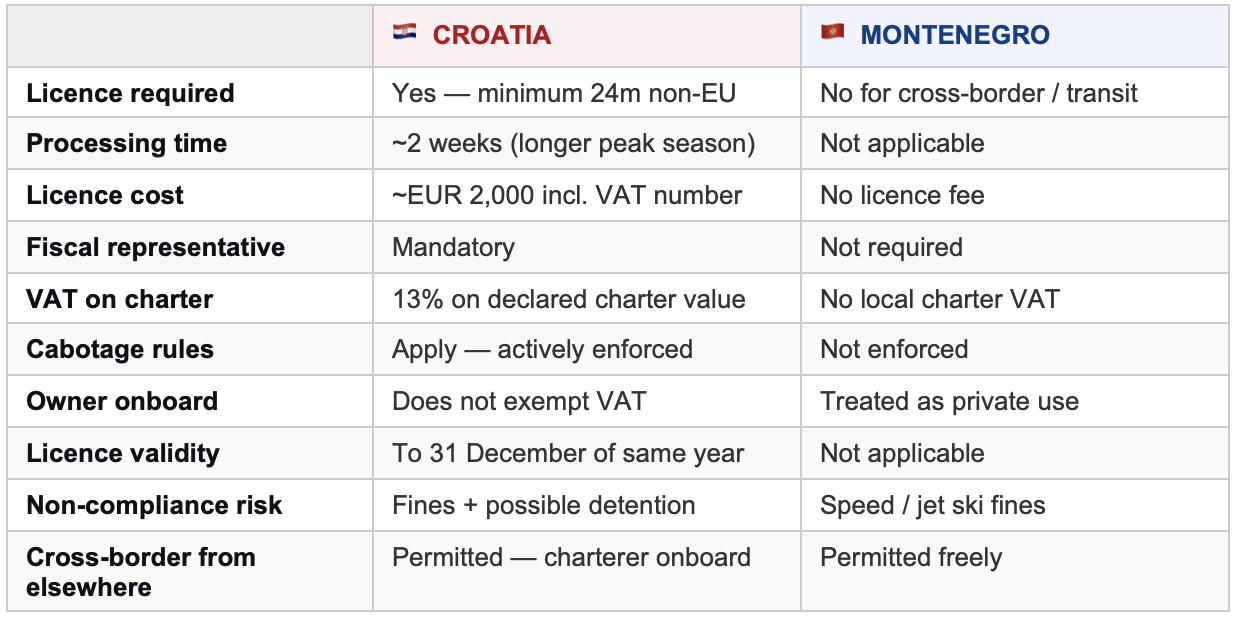
Croatia vs Montenegro: Charter Comparison
A+ Yachting is your dedicated superyacht agent for Croatia and Montenegro. We handle port authority coordination, clearance, bunkering, provisioning, charter licensing, spare parts logistics, and high-end concierge – all from a single point of contact.
Contact Gracija Matijevic: em.gnithcay-a@ajicarg | a-yachting.me